Showing posts with label Jaguar. Show all posts

Thursday, October 27, 2011

Ford’s drop from 10th to 20th place among 28 carmakers


Consumer Reports has published its 2011 annual auto survey in which the main point of interest, as the report states, is a sharp decline in Ford’s so far “solid reliability record”: the Detroit carmaker dropped 10 places in the overall reliability ranks.

According to CR's survey, which is based on responses from 1.3 million vehicles owners, Ford’s drop from 10th to 20th place among 28 carmakers can be attributed to two main factors. The first is that all three of Ford’s new models, i.e. the Explorer, Fiesta and Focus, scored below average in reliability in their first year on the market.

“We have often found that new or revamped models have more problems in their first year than in subsequent model years”, commented the senior director of Consumer Reports’ Automotive Test Center, David Champion. “Ford’s problems illustrate why we recommend to our subscribers to hold off buying a first-year model.”

The second factor that contributed to Ford’s decline is problems with new technologies, such as the MyfFord Touch infotainment system and the new PowerShift semi-automatic gearbox used in the Focus and Fiesta. The similar MyLincoln Touch system’s problems even affected Lincoln’s MKX, even though the brand was ranked above Ford. On the positive side, the Fusion Hybrid scored very well, and its other versions were above average.

Contrary to Ford, Chrysler has seen its reliability record improve significantly: Jeep is now the most reliable domestic brand in the U.S., having risen from 20th to 13th place. Dodge and Chrysler did not do badly either, moving up 12 and 3 places respectively.

Predictably, it is the Japanese that continue to dominate the reliability survey, securing the top nine positions of the scoreboard since of the 91 models that CR had sufficient data, 87 ranked average or better and 24 cars earned top marks. Scion (with two models ranked) led the pack, followed by Lexus, Acura, Mazda, Honda and Toyota.

Despite Chrysler’s improvement, the Detroit Big Three still haven’t caught up with their rivals, ranking not only below the Japanese but also the two Korean brands, Hyundai and Kia. GM’s Buick and Cadillac did worse than in 2010, with the LaCrosse, Enclave AWD and SRX scoring lower than last year and losing the “recommended” tag.

General Motors' best result was the Chevrolet Volt that was the group’s most reliable car, even though the sample was barely larger than the 100-unit minimum required by the survey and the cars were owned for only a few months.

European carmakers were, as always, a mixed lot: the highest-ranking brand was Volvo, at 10th spot, while VW retained its 16th place, and both BMW and Mercedes-Benz improved, though their line-up reliability was inconsistent.

The biggest loser was Porsche: in 2010 it was second best but this year it is second worst, due to only two models being ranked one of which, the second-generation Cayenne SUV, suffered many reliability problems.

Not surprisingly, given its record of accomplishment and decades-old bad reputation, Jaguar finished dead last as its XF and XJ luxury sedans were the two least reliable models in the entire survey.

Friday, September 9, 2011

Jaguar C-X16 Concept


Built as a true driver's sports car, the strictly two-seat C-X16 is the smallest Jaguar in terms of length since the 1954 XK120. The concept is built around a shortened version of the next generation XK's aluminium chassis structure and it measures 4,445 mm (175-in.) in length, 2,048 mm (80.6-in.) in width and 1,297 mm (51-in.) in height and has a wheelbase measuring 2,622 mm (103.2-in.).

Lurking under its long hood is hybrid powertrain that includes a next-generation 3.0-liter supercharged V6 petrol engine delivering 380-horses (280kW) and 332 lb ft (450 Nm) of torque and an electric motor generator integrated into the eight-speed automatic gearbox that transfers power to the rear wheels.

The electric motor draws power from a 1.6kWh battery pack mounted behind the seats that is charged through a brake energy regeneration system. The motor provides and additional 95-horsepower (70 kW) and 173 lb ft (235 Nm) of torque.

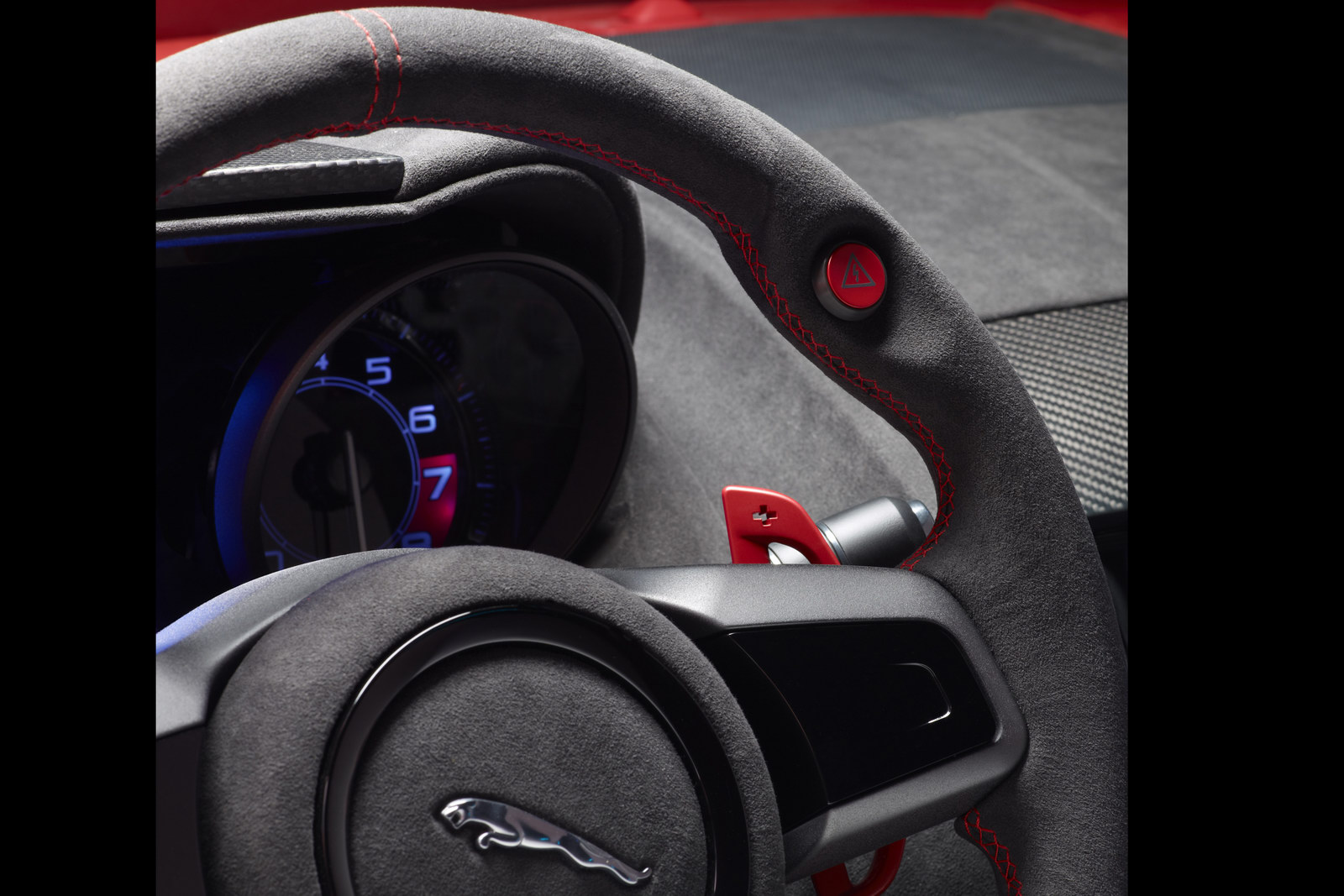
A Formula 1 Kinetic Energy Recovery System (KERS)-inspired hybrid boost system with a steering-wheel mounted button allows for on-demand acceleration using the electric motor.

Jaguar says the C-X16 tips the scales at 1,600kg (3,527 lbs) and has a perfect 50-50 weight distribution. According to the company, it is capable of accelerating from 0 to 62 mph (100km/h) in 4.4 seconds and from 50 to 75 mph (80-120km/h) in 2.1 seconds, while reaching a top speed of 186 mph (299km/h).

In addition, the British firm reveals that the C-X16 is able to travel at speeds of up to 50 mph (80km/h) using electric power alone and has CO2 emissions of 165 g/km.

The styling of the C-X16 is the work of Ian Callum. The exterior design mixes styling cues from both the XK (up front) and Jaguar's well received C-X75 hypercar study (at the back) from last year's Paris Auto Show, in a more compact form.

Like the exterior, the interior of the concept looks very close to production sans the trim and dramatic color choices. According to the British automaker, the inspiration for elements of its layout come from aeronautical ergonomics, such as the joystick-style gearlever and banks of toggle switches, which also refer to classic racing Jaguar cars.


Friday, August 12, 2011

Jaguar and Land Rover India PHOTO GALLERY

Tata Motors bought Jaguar and Land Rover from Ford in 2008, it had great plans for both brands. Driven by sales of the sub-$5,000 Nano, the Indian conglomerate would have enough funds to secure their future. Now it seems that the tables have turned, and it's the Jaguar Land Rover (JLR) unit that may have to bring in the profits.

Tata Motors reported an 8.5% drop in sales in India for the first quarter of 2011, due to rising interest rates in a country where, according to Bloomberg, 80% of new car sales are based on loans.

Demand for the Nano dropped by a whopping 48% in the last two months alone. Jaguar's global sales dropped even more in the first quarter, as the luxury carmaker reported a 27% decrease.

“Tata Motors had a pretty flat quarter as far as Jaguar sales are concerned, and Indian passenger vehicles sales went down” said Juergen Maier, a manager at Raiffeisen Capital Management in Vienna.

“Everyone is looking at the Evoque and also the product launches from Jaguar that will help increase sales”. Ashvin Chotai, the managing director of Intelligence Automotive Asia, agrees: “The company now revolves around the JLR unit and not the other way around”.

Fortunately for Tata, Land Rover is doing quite well: its sales in the past quarter grew by 22% to 50,747 units. And the Range Rover Evoque has already 18,000 orders even before it officially goes on sale in September, something that according to the brand’s director, John Edwards, will create a waiting list “well into next year” for new buyers.

Tata also has in the pipeline several Jaguar products including a Sport Break version of the XF and the exotic 200 mph C-X75 hybrid supercar. More importantly, Jaguar will launch a small sedan to rival luxury models like BMW’s 3-Series (hopefully with better results than the X-type).

In order to achieve its goals, the Tata Group plans to invest $2.4 billion annually in the development of 40 new products and variations of Jaguar and Land Rover models in the next five years.

Story source: Bloomberg


PHOTO GALLERY


Tuesday, June 28, 2011

aguar XF 2.2 Diesel Photos


Jaguar is touting it’s new diesel-powered XF 2.2D saloon as the most fuel-efficient model in its history and to back its claims, the company set out to complete a journey from its factory at Castle Bromwich in Birmingham, UK, to Munich, Germany, on a single tank of fuel.

The British company manages to achieve its goal, with the four-cylinder XF covering a distance of 816 miles or 1,312 kilometers on 64 liters of diesel fuel, which gives an average fuel economy of 57mpg UK, equal to 4.9 lt/100km and 47.5 mpg US.

David Madgwick, an independent tester, accompanied by navigator Alexander Madgwick, drove the vehicle, which left Jaguar’s facilities with a little over 3,000-miles on the clock.

The crew was met in Munich by Chief Programme Engineer for the XF, Andy Whyman, who commented:

“The entire development team is very proud of what the new XF 2.2 has achieved – this not only proves the efficiency of the new model but underlines that performance and economy can be combined,” said Andy Whyman, Chief Programme Engineer for the XF.

The new Jaguar XF 2.2D is powered by an updated version of the Ford-sourced 2.2-liter turbocharged four-cylinder engine found in the Land Rover Freelander and the European-market Ford Mondeo.

It produces 190-horses and 332 lbs ft of torque allowing the XF to accelerate from naught to 62mph (100km/h)in 8.5-seconds before reaching a top speed of 140mph (225 km/h).

The four-pot is connected to a new eight-speed ZF automatic gearbox and, in a first for Jaguar, a Stop-Start system.

It will join the rest of the facelifted XF range in Europe this September.


PHOTO GALLERY